Rebecca Handler

Two Stories

One

“I never wanted to tell you this but I stopped doing those yoga videos.”

“What?”

“You know how I go downstairs after dinner and do those videos?”

“I know, your yoga.”

“You always say it’s good for me.”

“But I hear it on, that gay guy telling you to breathe.”

“Yeah it’s on, I put it on. I just don’t do it. I lie down on my mat and do nothing.”

“That’s good for you Beth, that’s meditation.”

“It’s not meditation. I stare at the ceiling at all that chipped paint and that stupid light fixture. That nasty piece of gum stuck in the corner. I know Steven stuck it there, that time he stayed with us when he was on his way to Nevada. He had sex down there you know that right? He had sex with that girl, the one from the video store. Anyway, the point is that I’m not doing yoga.”

“Why are you telling me this now?”

“I don’t know. I’m just sick of it. I’m sick of all of it.”

“Come here, baby.”

“No.”

“Get over here. Sit down. Listen. I don’t give two shits that you hate yoga.”

“I don’t hate yoga.”

“You know what I mean. You think I’m sitting up here thinking my wife is so cool for doing yoga? No, I’m not thinking that. You know what I’m thinking?”

“No.”

“Ask me what I’m thinking when you’re downstairs not doing yoga.”

“What are you thinking?”

“I’m thinking I’m so fucking lucky. I just had a delicious dinner with my beautiful wife. My daughter’s got a great job in the city and just bought herself a car. My back hasn’t acted up in awhile, I’m sleeping good, life is good.”

“Oh Brian.”

“Don’t oh Brian me. I’m just being honest. You want some tea? I’ll make you some tea.”

“I’ll get it.”

“You’re not getting anything. You’re gonna sit there and have some tea. And then you know what we’re gonna to do? Ask me what we’re gonna do.”

“What are we going to do?”

“We’re gonna leave those dishes right where they are, and then we’re gonna go upstairs and go to bed. And tomorrow we’re gonna throw out that yoga mat and go see that fancy dresses movie you’ve been bugging me about.”

“Oh my god. You are ridiculous.”

“I’m ridiculous? Sit down. Breathe.”

Two

“I always knew that someday I’d see you again.”

“Come on.”

“No I’m serious, Jess. When was that time? Three, four years ago? I stopped in to return that video from my uncle’s house. Some yoga thing. I thought no one was here. You were putting movies back on the shelves. You called out from back there. You were wearing that stripey sweater and those cute black glasses. You said I couldn’t possibly imagine how many people were asking for that Demi Moore movie. You told me to guess, I should guess how many people. Just in that one day.”

“How can you possibly remember that?”

“You asked if you could help me with anything. I was just returning my uncle’s video but I stayed to look around. You showed me the new releases section and I think it was like Dances with Wolves or something like that. My aunt was like why did you rent this. I don’t even remember watching it, cuz all I could think about was you and how I was gonna go back the next day to return the movie even though it was a two-night deal.”

“I was glad you came back.”

“Yeah me too. We had fun that night.”

“Even though your uncle’s basement was freezing. My god Steven, you remember how cold it was? You thought I was being shy but I was freezing. My tits were literally frozen.”

“You just didn’t want to take your shirt off.”

“You’re insane.”

“You were chewing gum.”

“You made me spit it out.”

“When I got back in town the other night. I asked my uncle if that cute girl from the video store was still working there. He said as I matter of fact she still is.”

“How long are you in town for?”

“Depends.”

“I manage the store now.”

“You were basically doing that before, weren’t you?”

“No but for real now. The old manager left so they asked me to do it. About a year ago.”

“Good for you.”

“I get to decide on all the signs, make the schedule. I get to hire people. And you know… I need someone to cover this one girl’s shifts for a while. She just had a baby.”

“I like movies.”

“Name ten movies right now.”

“Kiss me.”

“Ten. Go.”

“Star Wars.”

“So predictable.”

“Shut up. Star Wars, Back to the Future, Raiders of the Lost Ark… that crocodile movie, the one with that knife guy… Rambo, Lethal Weapon, Die Hard…”

“Holy – Name one foreign film.”

“Oh come on.”

“Then how about a movie with a female lead?”

“Shit.”

“I don’t remember that one.”

“Shut up, I’m thinking.”

“Don’t hurt yourself.”

“Demi Moore! That Demi Moore movie!”

“You should be ashamed of yourself.”

“Am I hired?”

“Will you stay for awhile?”

“If you keep looking at me like that.”

______

(Inspired by Catherine Lacey’s Stepping Into Fiction workshop at the Perth Writers Festival last weekend. Our assignment was to write two stories: one that begins with, “I never wanted to tell you this but…” and another that begins, “I always knew that someday I’d see you again.” Catherine is the author of the wonderful novel Nobody Is Ever Missing.)

Bogan Bingo

The first thing I notice at Bogan Bingo is the bouncer’s fake tattoo: “Dilligaf.” I ask him what it means. “Does it look like I give a fuck?” he growls. Wow, that’s rude. As I make my way to the bar, it makes sense.

The event, held at our local primary school, is a fundraiser for suicide prevention. The invitation had stated, “Bogan Bingo gives everyone’s inner Bogan a chance to escape for the night. There will be beer, wine, pies, sausage rolls and sauce.”

I am wearing denim shorts, a Balinese beer tank top, sheepskin boots, purple eye shadow, and a tattoo with the name of my high school sweetheart. Dave is wearing more or less the same outfit, minus the makeup. One of our friends is in a Jack Daniels t-shirt that was a gift from his mother. Another has big hair, big cleavage, and a tattoo that says, “No Ragrets.” I spot close to 100 mullet wigs, a handful of fake pregnant bellies, and one pack of menthol cigarettes. We’re drinking white wine that tastes like Jolly Ranchers.

You Give Love a Bad Name is blaring on the speakers and bingo cards are scattered on our foldout table. The emcee yells out numbers followed by helpful hints: “Seventy-six! Eat a bag of dicks!” There’s also some call and response: “I say Up The Bum, you say No Babies!”

Bogan is a word that gets tossed around frequently in Perth. It’s a derogatory term for someone who is considered low status, unsophisticated. Rebel Wilson hit it big with Bogan Pride. A popular show here is Upper Middle Bogan. In America, Bogan translates to “white-trash” or “redneck,” two words I stopped using sometime in the early 90’s, along with “retarded” and “Benetton.”

Although Bogan is used by ladies in pearls to describe ladies with belly button rings, it is more often used by people who identify as Bogan. At the bar, a woman in an Aka Daka (AC/DC) t-shirt tells me she feels affection for the word because it describes her family. Her friend leans in, agreeing, “Bogans like to have a good time.”

Last week, I asked a few Australian children what they think of when they hear the word Bogan. “Heaps of tattoos and piercings,” one giggled as she reached for a biscuit. “They’re really loud, and they like cars,” another said. At needlepoint class, I asked my fellow students if they’d go to an event called Bogan Bingo. Looking up over her bifocals, Hazel said, “It’s in bad taste.” (She’s from England.) “Take pictures,” she added.

Dave nudges me. “This is amazing,” he whispers as I take my meat pie out of its plastic wrapping. A song I later learn is called Am I Ever Gonna See Your Face Again comes on. Everyone chants, “No way! Get fucked! Fuck off!”

I don’t think I’d attend a redneck-themed party in the U.S. I’d feel it was, at best, in poor taste, and perhaps offensive. Some Australians believe that Americans take certain things too seriously (what to say and how to say it) and other things not seriously enough (gun violence). I guess we’re livin’ on a prayer.

Style Guide

The Rotunda restaurant in San Francisco features service often found in Paris and I mean this in a good way – the wait staff is knowledgeable, over 40, and elegant in a manner that is neither ironic nor snobby. Plus, they use the scrape-y thing to wipe away your crumbs.

This classy establishment is on the fourth floor of Neiman Marcus in Union Square, under a dome constructed from tiny pieces of stained glass. As customers eat warm popovers with strawberry butter and sip Kir Royales, runway models sashay between tables, showcasing fancy dresses sold two floors down in Designer Apparel. The whole scene is very Ottoman Empire harem-chic, minus the eunuchs.

After a recent three-hour shopping spree that began with playtime at the MAC makeup counter and ended with the realization that sometimes the jeans I want don’t look good on me (Levis) and the jeans I don’t want look great on me (Eileen Fisher), I wandered into Neiman Marcus.

Stroking a vegan leather Stella McCartney dress, I began to crave a burger, so I took the escalator upstairs to the Rotunda and settled into one of the booths in the back.

“Michael, I’ve got to talk to you about those godforsaken bowls.”

A loud voice startled me. I looked up from my menu to see a woman in a silver top sitting at the table next to me, dangling her reading glasses from one hand, and pointing at her male dining companion with the other. “Michael,” she repeated, “I said I’ve got to talk to you about those awful bowls.”

Wearing a black turtleneck and a Burberry scarf, Michael glanced up from his phone with a look one might give a child who is asking for more syrup on her already drenched pancakes. “They’re gone,” he said with mild exasperation, “The bowls are gone.”

“Thank god,” the woman sighed as she took a sip of iced tea, put her glasses on, and examined her phone.

Please say something else. I beg you.

“Michael?”

Oh goodie.

“Michael?”

“Yes, what is it? I’m writing Kendra.”

“Michael, how many times over the past 12 years have I asked you to forward me emails from Kendra?”

I assumed the answer was many times. Jesus, Michael. Get your shit together.

Michael’s boss kept using his name as a status reminder. “Michael, when I tell you to do something, it’s just that. I’m telling you, I’m not asking you.” (I once had a boss who said my name constantly, often in conjunction with the phrase, “It’s so good of you to…”)

“Michael, just call her.”

“I’m writing this to Kendra: ‘Bonnie’s going to kill me if they don’t get us that style guide immediately.’”

Aha! Bonnie must run some sort of design company.

“Stop writing, Michael. I’ll call her.”

Oh no. Don’t answer, Kendra, don’t answer.

“Kendra, it’s Bonnie.”

Shit.

“Kendra, did you yes or did you no, get the style guide from Crystal?” Bonnie listened for a moment, slammed her phone on the table, took a long drag of iced tea and glared at Michael, “She says Crystal sent it.”

“If Crystal said she sent it, then she sent it.”

“Michael, the only thing I care about in that style guide is Mixed Metallics and Peach Shimmer.”

Michael was saved by the arrival of his roasted beet and burrata salad. “Yummy,” he said, still looking at his phone.

“What are these shrimp doing here? Didn’t I order the Cobb salad? Michael, what did I order?”

Six women, perhaps in their 70’s, walked past with shopping bags and brightly colored raincoats. One of them was holding a pink cake box. Bonnie called out, “Which one’s the birthday girl?” They pointed at their friend. “Don’t look so sad,” Bonnie smiled, “You’re still above ground so there’s that.”

Unwrapping his scarf and tugging gently at the top of his turtleneck, Michael carefully announced, “We need to talk about Judy.”

Bonnie grimaced as she used her fingers to transfer her shrimp to a bread plate. “I can’t talk about Judy for one more second. You’re very patient, Michael, for an impatient person.”

“Here’s the thing. Stay with me Bonnie. You go to a party and there are 10 people there. Two are above average, two are average, and two are below average. Judy and her team are below average.”

I was trying to figure out where the other four people were when a model drifted by in an off-the-shoulder black lace gown. Michael leaned over and said in a stage whisper, “She’s got to be a size double-zero.”

The model pivoted gracefully and glided over to their table. My burger arrived.

“It’s Oscar de la Renta,” the model told Bonnie and Michael. She lifted a corner of the gown to show the lace detail. “Isn’t it divine?”

Bonnie looked up from her phone and said, “Well it helps if you’re six feet tall and a hundred pounds.” The model looked down at her dress and responded, “Well, yes.”

I ate my burger slowly. Every bite seemed juicier than the last. Bonnie and Michael were quiet for a while, absorbed in their phones and their food. My waitress came over to ask if I was enjoying everything. It couldn’t be better.

In-flight

I am wondering whether or not it’s appropriate to watch Magic Mike XXL while sitting next to your children on an airplane. I’m just asking for a friend.

We are on our way back to Perth, via Singapore, via Seoul. Flight time is approximately 6200 hours. In addition to eye masks and fuzzy socks, flight attendants will be distributing new eyeballs and kneecaps. My eight-year-old is reading Harry Potter while chewing what I think is an entire pack of gum. The older one is watching a reality show called Blue Zoo where teenagers seem to be teaching dolphins how to collect and dispose of plastic water bottles which, when you think about it, is kind of brilliant. Clean up your own oceans, you lazy dolphins!

My mind has turned to mush after a visit to San Francisco. I blame the lack of exercise, the burritos, and a certain late night with certain friends who like to drink bourbon, make up songs about kangaroos sacks, and give me rides on their electric bicycles.

Waiting to board, I asked my daughter what it was like to see her friends after a year abroad. She smiled with relief, “It was great. They’re exactly the same.”

The city’s the same too. I could go on about all the techies moving in and snapchatting all over our cable cars, but when it comes to my hometown, I’m a crazed woman in love.

I am not in love, however, with the passenger two rows back who apparently has no problem sleeping on planes. Did you know that snoring is one of the top causes of divorce? My husband told me that.

Growing up, my family occasionally took day trips across the Golden Gate Bridge into Marin. We’d walk through a redwood forest, or see a community theater production of Annie Get Your Gun. Coming home, halfway through the rainbow tunnel, my mother would inevitably turn around and say to my brother and me, “Here it comes.” Then, as we exited the tunnel, Mom would sigh, “Have you ever seen anything more beautiful?”

That view – the bridge popping up through the fog and the city lights twinkling in the distance – is breathtaking. And fleeting. If you were say, sulking or goofing off with your brother, you’d miss it.

My meal choices are beef satay and fish curry. I pull some almonds out of my backpack.

“Girls, here it comes.” We drove through that tunnel just a few days ago, after visiting friends who recently got a puppy that likes to chew on shoes and pee under the dining table. (But who cares because he looks like a fuzzy profiterole.) I don’t know if my daughters noticed the view. They were poking each other. I thought of my mother and how she used to stare out the window and shake her head in disbelief. She was right. There is nothing more beautiful than seeing your home from a distance.

Crossing the Street in Hanoi

A man holding a sign with my name greets us at the Hanoi airport and drives us to our hotel in the Old Quarter. As we approach the city, motor scooters appear gradually, like raindrops before a storm. A lady in a blue dress with a baby strapped to her back rounds the corner at full speed. Her Hello Kitty helmet has a cutout in the back to allow for a ponytail. Businessmen in suits and facemasks zip in and out of traffic, checking their phones and lighting cigarettes. A man with 50 plastic red chairs secured to his Suzuki slows down to avoid colliding with an old woman transporting an enormous basket of lychees.

The scooter monsoon rapidly descends on our van. Hondas, Yamahas, families of four with purses and school bags, old men carrying fishing rods and lumber. Everyone weaving in and out of cars, flying through intersections, passing storefronts selling shoes, candy, dried fish, luggage and tea leaves. I grab my daughter’s hand. “Are you seeing this?”

Hanoi is a city with more than seven million people and an estimated four million motorbikes. With the exception of a few major thoroughfares, there are neither traffic lights nor stop signs. Watching the traffic from an air-conditioned van is mesmerizing. Crossing the street as a pedestrian is an entirely different basket of lychees.

We pull up in front of the hotel – aptly named La Siesta – and our American friends run out to greet us. Some are much taller than when we last saw them. We hug and laugh and hug again. “Look at where we are!” we all exclaim in various ways. “This is crazy!”

We drop our bags, grab water bottles, and set off to meet Viet, a hired local who will take us on a culinary adventure. “How will we cross the street?” I ask my friend Jason, in the calmest voice I can muster. “Just stay right behind me,” he responds, with the confidence one acquires after spending 24 hours in Hanoi.

The streets are loud and smell like grilled onions, petrol and papaya. Jason yells over his shoulder, “Everyone grab a kid.” I reach for a hand and squeeze it tight. I say a prayer: I apologize for stepping out into traffic and killing this child. Please forgive me.

We step off the curb in twos, like square dancers in a mosh pit. Scooters are barreling towards us from all sides. I focus on the back of Jason’s head, and pull the child closer. Somehow, magically, we make it.

We find Viet and eat rice noodles with pork belly. An hour later, over pho and lotus flower tea, my friend Lindsy says, “I think of Hanoi traffic as an organism. When we enter it, we are part of it. And when we exit, we leave it behind.”

Over the next two days, we cross many streets together. My prayer changes slightly: I still don’t want to kill this child but I really want to try the banh mi. Please forgive me.

The Bottle

I had a friend many years ago who was from France. We met in Singapore, where we’d visit each other in our air-conditioned apartments and watch our babies eat bananas. My friend wore seersucker dresses and plastic headbands, and was shy in that way non-native English speakers can be sometimes. I told her we should speak in French so I could practice. She’d laugh at me when I began every sentence with “I am going to,” and would interrupt me in English to say, “Now I am going to speak in English.”

One day, while watching our babies gnaw on wooden puzzle pieces, my friend shared some good news. Her younger sister was coming to visit. The sister was 14 and this would be her first time flying alone. My friend told me all the things they would do together in Singapore. “She wants to try spicy food,” she said, “and go on the Night Safari.” Then she paused, and asked quietly, “Can I tell you something?” Of course, I said. Tell me.

“My sister takes a bottle before bed.”

“Like a baby bottle?”

“Yes. My sister drinks a bottle before bed.”

It turns out that her mother just never stopped giving her sister a bottle of warm milk. And now she was 14, and still had a bottle every night. No, she did not have any disabilities. No, she was not still nursing. No, she did not tell anyone about this. Not a soul.

My friend hadn’t lived with her sister for many years, and was wondering whether or not the bottle would also be coming to Singapore.

I was thrilled with this piece of news. It seemed so strange, so wonderfully foreign. I couldn’t wait to meet this girl, and felt both guilty and gleeful that I was privy to her secret.

I met the sister at a barbecue. She was beautiful and slightly awkward – your average teenager. I kept glancing over at my friend, trying to catch her eye, hoping for a clue.

“What ever happened with the bottle?” I finally had a chance to ask, after the sister had returned to France. “Oh yes,” my friend said casually, “She brought one but didn’t use it. At least I don’t think she used it. I saw it in her suitcase.”

I remembered this story today, as I walked to pick up my daughters from school. My friend’s sister must be in her mid-twenties by now. I’m guessing the bottle finally faded away, as do so many elements of childhood.

Hardship

Ghaith is a Syrian refugee who fled to Sweden, by way of Lebanon, Turkey, Greece, Serbia, Austria, and Germany. He left his wife and mother to try and build a life for them that won’t involve car bombs and streets littered with body parts. He walked for miles, hid in train bathrooms and pickup trucks, and helped care for a pregnant woman and her toddler on a tiny boat that barely made it to shore. He cried when he finally reunited with his brother he hadn’t seen in three years.

I read Ghaith’s story in The New Yorker, from the comfort of my bed that was shipped from San Francisco to Perth by a company that wants to help ease my transition to a new country.

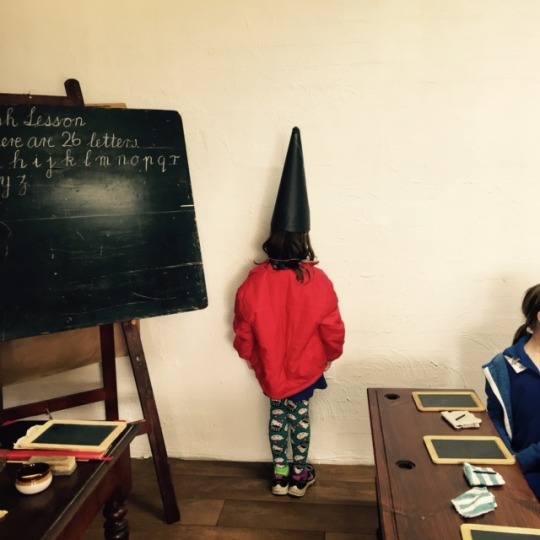
I recently chaperoned a field trip to the Freshwater Bay Museum, which, despite its name, is neither an aquarium nor a museum. It is an activity center where children can experience the lives of Australian settlers in the 1860’s. Twenty-four children in polyester blue school uniforms scrubbed tea towels on washboards, made scones out of crushed wheat, and were assigned new names like Emma Atkinson and Benjamin Sutton.

The children were asked to line up single file and take a seat in a classroom that was decked out with wooden pews and slate boards. “Girls up front, boys in back.” Pip, our tour guide who, up until this point, had been patient and kind with the children, tied on a white apron and announced she was now Mrs. Herbert.

Mrs. Herbert checked fingernails for dirt and slapped desks with her ruler. “Are you being naughty, Sarah Gallop? Do you want me to whack you?” “No.” “No, what?” “No, Mrs. Herbert.”

The children were given a spelling test. Pip asked for a volunteer to pretend to have failed. My daughter’s friend Daisy raised her hand high. Mrs. Herbert said, “Charlotte Yates, you have done very poorly on this test. Come here this instant.” Mrs. Herbert reached behind her desk and pulled out a tall cap with the word “Dunce” on it. For the remainder of the class, Daisy faced the wall, giggling with delight.

“Let’s play Olden Days!” Simone yells out to Daisy, as they run to our house after school, zipping past kookaburras and jacaranda trees. “I’ll be the student and you be the mean teacher,” Daisy commands, tossing her backpack on the floor and pulling off her sneakers. For hours, the girls speak very sternly, pretend to whack each other with rulers, and write the alphabet over and over. I knock on the bedroom door and ask if they want a snack. They tell me they’re not allowed to eat. “We might get whacked!” they shriek.

I’d bet my life these girls will never spend a week on a tiny boat with scared strangers, vomiting into ziplock bags and tossing them overboard. But I’ve never had to bet my life.

Oy to the World

When my younger daughter was six, she informed me, between mouthfuls of frozen peas, “There’s no such thing as Santa. It’s the parents.” I leaned over the table, looked her straight in the eye and said, “You are correct. Now please don’t tell anyone.”

And just like that, the ancient Jewish ritual known as Don’t Ruin Christmas was passed down to the next generation.

I admire Santa’s pro-nice, anti-naughty platform. But Santa will never squeeze himself down our chimney. I can explain this to my children in one of two ways– either a) he doesn’t exist or b) anti-Semitism.

Being Jewish this time of year is like being in a rowboat at night, looking up at the stars and feeling content, when suddenly a cruise ship passes by, with its twinkling lights and booming music. The same rowboat that felt comfortable a minute ago, suddenly feels small and insignificant.

This is not a sob story. I love Hanukah, and I love celebrating Christmas with my in-laws (via Skype, sniff). I just don’t want to do it every minute of every day in the month of December and, oh hey while we’re at it, also November.

Here in Australia, Christmas is full on. As my friend Anthony puts it, “It’s all about barbies, beer and the beach, what’s not to like?” Excellent point, mate. But in Oz, there is no Thanksgiving to serve as bouncer. The holiday has been in full swing pretty much since the beginning of November. And not just in coffee shops and department stores.

My daughter’s public school classroom features a theme each term around which activities and lessons are planned. So far this year, the themes have been Marine Life, Planets and Space, and Dinosaurs. This term? Christmas. My daughter will be making ornaments, learning carols, and drawing pictures of a bearded man in a red suit who she knows either a) doesn’t exist or b) anti-Semitism. I asked a Muslim mother how she handles things at the school and she sighed in that way you might if you found yourself in a rap battle with Jay-Z.

Another classroom recently launched “Santa Countdown” or, if you don’t celebrate Christmas, “Countdown to The Day Everything is Closed and You Forget Why But Then You Remember.”

Religions are like diets. There are many to choose from, and not choosing one is also a healthy option. Some households might be vegetarian, or paleo, or everything in moderation, and it’s all fine with me as long as you’re not ripping up my front lawn to grow your special beans.

Some people like to say that Christmas is not a religious holiday. But those people usually celebrate Christmas. Celebrating Christmas in a classroom alienates children who do not celebrate this holiday in their homes. I repeat. I repeat the sounding joy.

The 24

A wall in the shower is covered in gray tile. One of the little hexagons is cracked in such a way that it looks like the profile of a wolf. You stare at it while soaping your armpits, and think if your life were a Miyazaki movie, the tiny wolf would come to life and follow you around, protecting you from evil spirits. It would say things like, “Let your heart guide you,” and rest on your pillow at night, its green eyes glowing.

You buy a newspaper before waiting for the bus on St. Georges Terrace. You signal the 24 and it comes to a halt. “G’day,” says the driver. “Hello,” you respond, as you fold your newspaper and brush off some crumbs on the front seat. It’s after lunch, and the bus carries just a few other passengers.

A woman with bright pink cheeks gets on at the next stop. She looks out of breath. You notice the woman’s hair, long and white, with pink and purple streaks. The woman holds her SmartRider card up to the scanner, and sighs with relief when it beeps.

You open your newspaper. Something horrible has happened in Paris. A map with tiny stick figures compares the number of attackers to the number of victims. You sigh. What the hell is wrong with people. You get a text from Cassy. It’s a link to a video of cats being startled by cucumbers. “Try this with Finn,” Cassy writes. You chuckle. France has declared war on terrorism.

Someone has pushed the button signaling the driver to pull over at the next stop. The back door opens and a piercing scream breaks the silence like a meteorite crash in the desert. “It’s ripped off! It’s all gone!” You look behind you and realize the scream is coming from the woman with the white hair with the pink and purple streaks. Tonight you will use the words “freak accident” to describe to your children what happened to this woman. The bus door has ripped off the entire nail of her big toe.

A passenger runs over to her. “Come with me,” he says calmly, in thickly accented English, “I’m going to help you.” He holds up the woman as she stumbles over to the bus shelter. Her foot is covered in blood. The woman is sobbing.

Through the window of the bus, you watch the man as he helps the woman onto a bench and props up her bloody foot on his knee. The blood is getting all over his pants. The woman is shaking and howling in pain.

The bus driver joins them outside. He crouches next to the woman and leans in to say something to her. He reaches into his pocket and offers his handkerchief to the man who quickly wraps it around her foot. The driver boards the bus for a moment to call someone. “One of my passengers is hurt. We will be here for a while. Yes. Thank you.”

You remove your wallet and phone from your purse and search the pockets for Band-Aids, coming up with nothing. You leave your purse and the newspaper on your seat and go outside. You ask the man, still holding the woman’s foot, “Can I call someone? Do you need an ambulance?” He says no, the woman just called her husband. He is on his way.

You sit down next to the woman with the white hair with the pink and purple streaks and rest your hand gently on her back. “It will be ok,” is all you think to say. She collapses back into your palm, and starts to cry again. “I can’t believe this happened,” she moans, “I’m supposed to go hiking in January.”

One by one, the remaining passengers disembark. An older lady has tissues and stories of awful toenail injuries from when she was a ballerina. “Toes heal quickly, trust me.” A passenger with a long blond ponytail is on her way from waitressing downtown to coaching gymnastics. “I’ll be late but it doesn’t matter.” A young man dressed in all black comes over to the bench and hands the woman an unopened bottle of water.

You feel bad about not having any Band-Aids, and say to the man with blood on his pants, “You should be a doctor.” He blushes. “I hope to be one soon.” It turns out he’s in medical school up the road. Everyone laughs, including the injured woman who shakes her head in disbelief, “What are the chances?”

The husband arrives. “Oh Junie Bug,” he says sweetly, putting his hand to her cheek. His wife starts crying again. “All these people took such good care of me.” “Of course they did, Junie Bug, of course they did.”

Everyone says goodbye to the woman with the white hair with the pink and purple streaks and gets back on the bus, returning to their original seats. You read the newspaper the rest of the way home. Many of those people in Paris were at a rock show.

Later that night you take a shower. You stare at the wolf and think about scary things. Then you think about all the kindness, all of the people looking out for each other.

I Woke Up Happy

Ladies, if you didn’t come to work, I need you to leave right now. Work those hips. I see you over there acting like you’re tired. Are you ready? Work.

Who writes the lyrics to Zumba songs? A five-year-old playing Mean Boss?

I’m not supposed to be thinking about what’s on the stereo. I am meant to be learning very complicated dance moves in an exercise studio at the Next Gen Club in Kings Park, Perth.

My friend Lucia is an irresistible saleswoman with toned arms and a contagious laugh. She loves her weekly Zumba class and invited me to join her. Lucia’s wearing her party pants – neon print spandex capris – so I know she means business. I am wearing black leggings and a panty liner, my go-to outfit for any activity that might require excessive jumping.

Zumba has its roots in hip-hop, salsa and meringue, so I know this class will feature a lot of booty shaking. Scanning the room, I make an unfounded assumption that I will be able to keep up with these ladies.

The regular Zumbies are in the front row. Jo from Facts of Life is sporting baggy, gray Hammer pants, and her friend is wearing a black t-shirt with the phrase, “I Woke Up Happy.” They are smiling ear to ear and greet the instructor with the kind of affection normally bestowed upon baby penguins in hand-knit sweaters. The teacher is a stand-in for Goldie Hawn in the second half of Overboard– effortlessly sexy in loose-fitting clothes and no makeup.

The music starts. We’re sidestepping and clapping. I can totally handle this.

A minute later, I’m trying to roll my torso in a way that is supposed to be sexy but when I do it, it looks like I’m dodging a tetherball. There’s pivoting, lunging, kicking, and lots of hair flipping. I think of the Joseph Campbell quote I saw in a bathroom stall, “We must be willing to let go of the life we have planned so as to have the life that is waiting for us.” I do some shoulder shimmies.

The regulars are nailing it. Their movements look relaxed and natural, and their faces are glowing with sweat and delight. They make a lot of eye contact with each other. During a song that, based on its relentless chorus, I’m guessing is called “Fed Up,” we do this dance move that involves punching your elbow to the side as if fighting your way onto the subway. The regulars think this gesture is hysterical and give each other looks like, “So happy to be rid of that loser, right? I showed him.”

During a break between songs, I turn to Lucia, “This is hard.” She smiles, “It’s like a party.”