The Houseguest

This week we have a houseguest, a young American we met a few months ago while traveling in a remote region of Western Australia called Monkey Mia, which, despite its name, is home to dolphins not monkeys. Also, Mia is pronounced Maya.

Anna, pronounced Anna, is an actress and a waitress and a searcher. Her visit is perfectly timed. She has a Millennial ease about her that makes me feel like America is going to be all right because her generation believes in compassion and fewer weapons and equal rights, and it’s all a matter of time. She brought us clay face masks and sparklers.

“When will we see you again?” my husband asked Anna last night before we went to sleep after sharing a bottle of Shiraz and talking about Bernie Sanders and Gilmore Girls. He was missing her while she was still here, one of Dave’s hallmarks. I knew how he felt.

In the spring of 1996, Dave and I stayed in the London home of a couple we had met at a house party in Boston, six months earlier. This couple spent the party cuddling on a couch radiating romance and mystery, and we spent the evening trying to be more like them. Galina was Ukrainian and her purple bra strap peeked out from her loose fitting sweater. Christophe was French and wore leather and smelled of cigarettes. They unsuctioned long enough to tell us that they had just completed a cross-country drive on motorcycle. Of course they rode motorcycles. These were not the kind of people who were going to waste time in the safety and banality of cars. I was transfixed, and when they offered their home as a layover on our way to Ireland later that year, I promised we would come. Few of us were internetting back then, so for months, I kept Galina’s phone number on a slip of paper in my underwear drawer.

Looking back now, they probably thought we were adorable. We were both twenty-two and newly in love. Dave had graduated from college and was very skinny then in his gray turtleneck sweater and jean jacket. I had dropped out of college and used my Legal Seafood waitressing money to buy my first pair of Doc Martens. We had only recently upgraded our multi-year friendship to what Australians would describe as full on. The trip to Ireland had been Dave’s idea. He had never traveled outside the U.S. and wanted to see his maternal family’s homeland. His mother would suddenly pass away soon after our return and of course we didn’t know that then, so that trip holds particular significance for both of us.

Galina and Christophe were in their mid-thirties and their art-filled Hampstead apartment had a red crushed velvet couch and a vintage record player. Galina allowed her husband to smoke inside but only next to an open window. With Christophe perched on the windowsill and his wife reclined on the sofa sipping an aperitif, we spoke of philosophy and travel. Dave and I occasionally exchanged looks conveying we are most certainly in the company of grown-ups.

We never saw Galina and Christophe again, but I thought of them last night as I said goodnight to our houseguest and crawled into bed. I thought about all the different kinds of relationships we have with all kinds of people, and how we’re all floating through space, occasionally bumping into each other. Some people are like satellites to us, and others are shooting stars.
The Audience Is Listening

I noticed him when we first arrived at the theater. He was hard to miss – a paralyzed man in a wheelchair being pushed by a beautiful woman with thick black braids. His face was contorted and his head leaned significantly to one side. The large wheelchair chair was tilted back, La-Z-Boy style, and his white sneakers looked brand new, as they would I suppose. I guessed he was about thirty. I wondered how long he’d been like this. “Blind from birth is what you want,” a visually impaired friend once told me. “To not know any different.” This friend had become blind at age eight, and still had memories of colors, which occasionally brought him immense sadness. After he lost his sight, his dad would drive him to big grassy fields so he could run fast and fall down safely.

The man in the wheelchair is now parked in the front of the stage. We are all here to see the Mucky Duck Bush Band, an Australian folk trio who has played together for forty years. They sing wistful songs about pretty Irish girls and soldiers returning from war. One of the performers, a friend here in Perth, asked my daughters to dance on stage during one of their songs. The girls are next to me, slightly fidgety with anticipation. “I don’t remember some of the steps,” the younger one had confessed to me this morning.

“It’s ok,” I had responded. “Just smile and try to have fun. People like to see other people enjoying themselves.”

The musicians walk out on stage with their various string instruments and within seconds, I’m tapping my feet and grinning ear to ear. It’s the kind of music that makes me want to live somewhere with a wrap-around porch and a shirtless banjo-playing wheat farmer.

Just as my wheat farmer is serenading me on the veranda, a loud noise erupts from the front of the auditorium. It is a primal groan, like an animal giving birth. The noise clearly startles the crowd and people crane their necks to see where it came from. It is the man in the wheelchair. The performers shift their gazes slightly but seem undeterred. I imagine after forty years, they’ve seen and heard everything.

He groans again, and also several times during the next song, a little ditty about Marco Polo.

Over the course of the next few songs, the audience’s collective curiosity and uneasiness morph into compassion and acceptance. We get it. This is not the sound of someone in pain. This is the sound of someone having a blast.

The girls dance beautifully and we walk to the lobby at intermission to stretch our legs. The younger one quietly inquires, “Why was the man making all that noise?” We talk about disabilities and some of us learn the word inadvertent. And then we eat some chocolate and go back in for the second half of the show.

During a silly song about all the animals in Australia that can kill you, the man in the wheelchair is particularly vocal. My younger daughter leans over to me with a huge smile and whispers, “He’s really enjoying himself.”

“It’s fun to see people enjoying themselves, isn’t it?” I whisper back.

She nods and squeezes my arm.

Lights Out

“The problem is, I have a bad memory and I’m half-black.”

“Huh?”

“I never remember anyone, but they always remember me.”

“Because you stand out.”

“Because I’m the only half-black person they’ve ever met.”

“Maybe it’s because you’re gorgeous.”

“Yeah that’s it.”

“Or maybe they’re like, hey that’s Gregory Hines.”

“No one thinks about Gregory Hines.”

“No one’s thought about Gregory Hines until they see you.”

“And they’re like, there’s that tap dancer from that movie that was on TV twenty years ago.”

“Did you read more about Dallas?”

“Fucking nuts. I guess it was inevitable. Crazy violence without justice causes more crazy violence.”

“I’m the only Jew some people have ever met.”

“That’s different.”

“I know.”

“Remember Mark from that summer program? He grew up in Beverly Hills and got pulled over basically every time he drove home.”

“BMW, right?”

“And my brother when he was leaving our grandparents’ house?”

“That was insane.”

“Our grandfather was a cop for god’s sake.”

“Everyone’s so angry.”

“Everyone’s always been angry.”

“Did you do lights out?”

“I was just about to. Did they practice tonight?”

“This morning before school.”

“Did you turn in the form?”

“Yep. That campus is huge. There’s like 2,000 students… Anyway, you really don’t remember her? She came to that party we had and wouldn’t leave. She had those cool boots.”

“Everyone has cool boots.”

“She was asking me about you.”

“Yeah cuz I’m the only black person she knows.”

“It’s eight-thirty. Can you do lights out?”

Meaner Maid

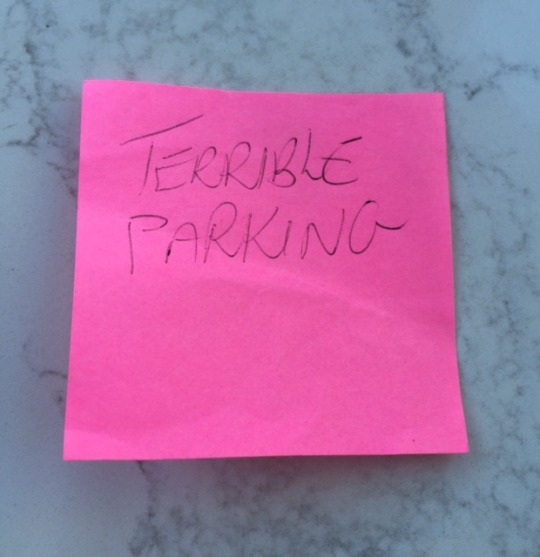
Notes left on cars should fall into one of two categories: 1) I’m sorry I smashed your side mirror call me, or 2) 25% off Psychic Palm Reading. A hot pink handwritten post-it declaring “Terrible Parking” does not fall into either of these.

First, the facts. This was a grocery store parking lot, spots tightly crammed together, and I pulled in between two sedans, so it couldn’t have been that bad let’s be realistic.

Did the author of Post-It: A Memoir in Two Words try to pull in next to me but couldn’t? Did my slightly slanted parking job trigger her obsessive-compulsive disorder? Was she unhappy that the store ran out of muesli? Did she leave a note in the produce section because the carrots were not arranged in a perfect pyramid?

I bet she was talking on the phone at checkout.

My daughters had jumped in the back seat before seeing the note, so after I got in the car, I turned around to show them. “Guys, look what someone left me.”

“That’s mean,” said the younger one.

“Did you do a bad job parking?” asked the preteen.

“You tell me. Come look.” The three of us got out of the car and stood behind it, tilting our heads and staring at the back bumper as if it were contemporary art.

It was not my finest work but terrible? Please. I’ll tell you something terrible. There are these duck-like birds called coots that live at the lake near my house. When coot chicks beg their mother for food, the mother sometimes pecks or starves them to death. That’s terrible. I sometimes mention the fate of these birds to my children when they start asking me when dinner will be ready.

“I guess you’re a little over to one side,” said the younger one, peeling a cheese stick.

“Who would write a note like that?” said the preteen, having rejoined Team Mom.

We got back in the car, buckled in, and started to back up. “That’s her! That’s her!” said the younger one excitedly, pointing to a woman walking past holding a bouquet of sunflowers. I told her it’s impossible to tell and she said, “Well she looks grumpy. I bet she did it.”

“Should I roll down the window and yell, ‘Terrible Flowers!’ at her?” I asked my children, who were instantly horrified by the reminder that their mother is always mere seconds away from extreme embarrassment.

“Mom! Don’t!”

I asked them what sort of note would have been more helpful to leave on someone’s car window. I suggested something like, “Next time, please park more towards the center of your spot. It made it difficult to pull out. Thanks.”

“How about no note?” they said. No note would have been fine too.

She’ll Be Right

“I’m Jules and this sweet girl is Maddie.”

“Well hello there, Maddie. This here is Baby Jack. I’m Roz.”

“Where did you get Jack’s shirt? I’m Delicious. Isn’t that the cutest thing?”

“Country Road Kids. It was on the sale rack. I only look at their sale rack.”

“I know, right? It’s not like they’re going to wear it for more than a few weeks.”

“Forty bucks for a onesie. I can’t believe they get away with it.”

“First time?”

“Is it that obvious?”

“Good on ya. Trust me, you won’t regret it.”

“How many times for you?”

“Heaps. This is the fifth.”

“You look twenty-four! How is that possible?”

“Honestly, after the first time, I couldn’t wait to do it again. Once we had twins, which was ace. Shane wasn’t so sure, but I made him come along one time and now he’s hooked. They make it easy. You don’t see a thing. Oh, here comes the waiter.”

“Can I get you ladies anything? Cappuccino? Flat white?”

“Roz, you ready?”

“It’s now or never. Jules and I will both have… we will both…”

“We’ll have the house scones with cream and raspberry jam.”

“A brave and excellent choice, ladies. Hold on, let me put my pen away. Ok. I can take em.”

“Goodbye Maddie. Mommy loves you.”

“Jack, go with this nice man.”

“Ladies, you’ve done quite a job with these two. They are lovely babies. I’m Delicious. How cute is that? The dingoes would have a real chuckle.”

“It’s from Country Road Kids. The sale rack.”

“I’ll be right back with your order.”

What’s Broken

Everything in Australia has a nickname. Breakfast is brekkie, gas stations are servos, and paramedics are ambos. Electricians are called sparkies.

Our bathroom light had been malfunctioning for several weeks. It flipped on ok, but then just when you were in the middle of brushing your teeth or applying eye cream, it would turn off without a warning. So there you’d be in the dark, fiddling around with the faucet or trying to find a washcloth.

We are not quick to fix things, so our solution had been to leave the bathroom door open and the hall light on, just in case you were suddenly left in the dark, half-flossed or naked.

Finally we called a sparky. “How’s tomorrow morning?” he said. Tomorrow’s great.

He showed up right on time wearing a mechanic’s jumpsuit with his name embroidered on the front pocket. “Tom,” he showed me, pointing to his chest.

“Rebecca,” I said, pointing towards the bathroom.

Tom was enormous and had a Miley Cyrus haircut, short on the sides with a longer bit on top tied back in a ponytail. As he wiped his feet on the mat, I caught a glimpse of his large neck tattoo – a woman’s face, her long hair appearing to cascade down his back. I wondered if he had her entire body inked on his. If she were drawn to scale, her toes would touch his waist.

He followed me down the hall to the bathroom. I showed him the broken light, which is affixed to the medicine cabinet. He opened the mirrored doors and moved the shaving cream out of the way to get a better look at the problem. As he played with the wires, I counted the number of nail clippers we keep in there. Four. We also have two pairs of tweezers and two tubes of anti-itch cream.

“Maybe I should take this stuff out,” I said. “It’d be easier for you to fix the light.”

“Ta. I’ll get my tools and be right back.” As he tucked a stray hair behind his ear, I noticed that Tom had a large gun tattooed on the back of his hand. A black pistol, lined up with his thumb and pointer finger, so if you were playing Cops and Robbers and pretending to hold a gun, you could really scare everyone. Bang bang.

As the giant man with the gun tattoo went to get some sharp tools from his windowless van, I cleaned out the medicine cabinet. Lipsticks, mascara, toothpaste, four nail clippers, two tubes of anti-itch cream, all now in the bathtub.

Tom arranged his tools on the sink. I was mistaken about the number of gun tattoos. In fact there were two, one on each hand. “I’ll be in the kitchen,” I said. “Let me know if you need anything.”

I made myself some tea and texted Dave. Sparky has gun tattoos. I didn’t hear back. He was probably in a meeting.

I opened the The New York Times. Massacre in Orlando. I read every article while my tea got cold. A mother hadn’t heard from her son. The killer’s ex-wife said he was violent and mentally unstable. In Florida, you don’t need a permit or a license to buy a rifle, shotgun or handgun.

“Come look.” Tom stood in the doorway, taking up most of it.

“Canadian?” he asked as we walked into the bathroom.

“American,” I responded quietly.

“Such a shame about the gorilla,” he said. “That poor mum.” Tom had obviously not seen today’s news.

He showed me how he had repaired the wires and flicked the lights on and off several times. “You should be all set.” He smiled sweetly. I walked him to the door and we shook hands.

Who knows why a man would walk into a tattoo parlor and leave with guns on his hands. The story could be one of passion or revenge, or it could be nothing like that at all. But they’re not hurting anyone.

The Spirit Of The Cacao

There were many kinds of girls in middle school. There were the tough girls who had hickeys and lip liner and pierced their own ears, the “grown-up” ones who wore stockings and slingbacks, and the tomboys who played in band and wrote in permanent marker on their K-Swiss.

And then there were the girls I envied the most, the ones who seemed to be made of incense and linen. I’m sure, like most preteens, these festival girls, with their leather sandals and messy hair, meticulously cultivated their Virgin Suicides-meets-Woodstock look. But to me, they appeared absolutely effortless, like they were born wearing belly-dancing scarves around their waists. I imagine their homes were filled with beads hanging from the doorways, Indian silk throw pillows and the smell of chai.

I thought of these girls recently when I attended an event called Shamanic Cacao Ceremony & Sacred Ecstatic Dance.

As it turns out, Perth is not just home to Olympic athletes and sports therapy clinics. It also boasts an impressive number of white people with dreadlocks who dance like no one’s watching, except there is someone watching and her name is Rebecca.

My friend Druimé wrote on Facebook that she had an extra ticket to this event, and before you can say electronic didgeridoo, I was making plans for her to pick me up at 6:30 that night.

I spent the afternoon reviewing the event details and googling shamanic cacao ceremony. Cacao promotes focus and insight. Prior to ingesting cacao, five hours of fasting is recommended. I read the event description aloud to Dave and he asked, “Are you sure nothing else is added to the cacao?” I assured him no, we will not be deported because I overdosed on spiked Guatemalan cocoa beans and was found wearing silver ear cuffs, wandering the streets of North Perth.

Curiously, I was not leery of the Sacred Ecstatic Dance part of the invitation. Although I had never personally attended this sort of event, I understood the basics thanks to my friend Alex, an ecstatic dance enthusiast. I understood that there would be candles and a DJ, but, unlike a nightclub, it would be silent and alcohol-free.

On the way over, I asked Druimé if anyone would try to touch me. She giggled and promised I’d be left alone. She then added that if I felt that way, I should never attend a tantric cacao ceremony. I confessed to her that I just ate a ton of cheese and crackers, which doesn’t technically count as fasting. She said she just had some cake and I shouldn’t worry about it.

When we entered the North Perth Town Hall, we removed our shoes, dropped our bags in the corner, and squeezed ourselves into a large circle of twenty-somethings, all sitting cross-legged with their eyes closed. I’m old, I thought, as my knee joints cracked and I plopped on a pillow.

Khaleesi was walking around the circle beating a drum. Blond hair piled atop her head, she wore a long backless white dress and gold bracelets (post-event internet-stalking would reveal she speaks to trees and looks amazing in eyeliner). Her assistant, also gorgeous and also in white, handed out Dixie cups of room temperature hot chocolate.

“Take the first sip of the sacred cacao.” Khaleesi led us through the ceremony, which involved drinking this bitter brown liquid that no amount of whipped cream and marshmallows would have rescued. “Imagine the crown of your head is covered with one thousand petals from a lotus flower.”

I wanted to shoot back the cacao as quickly as possible but followed the instructions to sip slowly, holding out hope that soon I would be super high.

No such luck. The only sacred cacao high I experienced was the high of dehydration, which I quickly cured by chugging my Chevron water bottle. This was around the time Khaleesi used the phrase “inter-dimensional midwife” and I unintentionally let out a little snort.

After chanting exactly 108 oms, we stood up and the DJ, also in white, started playing something I swear I heard in a Volkswagon commercial ten years ago.

Then came the good part. Man, I love dancing. I got to dance with the cool girls, the girls in halter tops and prairie skirts, and some beautiful delicate men too, the likes I haven’t seen since San Francisco. Swinging my arms around, I accidentally bumped into a skinny man with pigtails who looked like Alan Cumming in Anniversary Party. I mouthed “Sorry,” and he put his hands in prayer position and then darted across the room like Tinkerbell.

After some “find someone you connect with and bow to each other” business that I could have done without, the evening ended with chai. Of course it did. Because I am beautiful and effortless and drink chai.

The Trip Of All Trips

In case you are wondering, if you deposit an Australian 10-cent coin into a San Francisco parking meter, you get one minute.

The 10-cent coin features the Queen on one side and on the other, a male lyrebird, tail feathers on display. Lyrebirds mimic other birds, and also things like crying babies and car alarms. What fun that must be.

Two weeks ago I learned that an old friend of mine, and by old I mean 98, had become ill. My husband told me to get on a plane, he’s got this, so I packed a carry-on and flew to San Francisco in a magical time-changing machine with cold dinner rolls and tiny bottles of wine. The next day, I was in Beate’s living room.

She opened her eyes and said, “What are you doing here?” I trimmed her nails and asked if she was thirsty.

Beate has wonderful care at home, and is surrounded by her plants and many knick-knacks, including an impressive assortment of schnauzer figurines and a solar-powered dancing sunflower still in its packaging. She sips tea from her glass mug, and has an occasional bite of soft-boiled egg. Most of the time she sleeps.

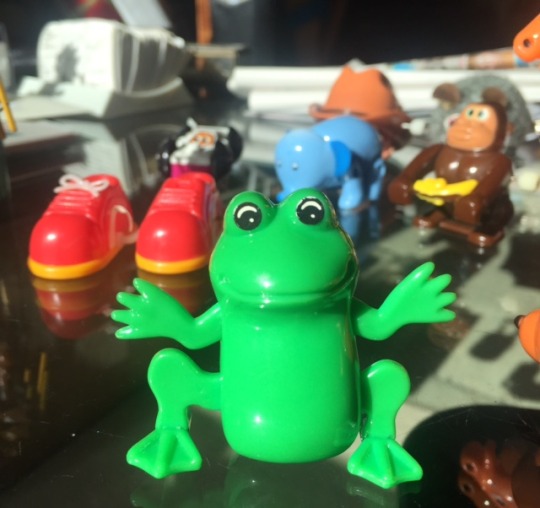
For as long as I can remember, Beate has owned a collection of wind-up toys that she keeps in a round Chinese hat with long fringe braids. There’s a frog with jazz hands that moves from side to side, a cowboy hat that darts around spastically, and a monkey that does somersaults. My brother and I spent a good chunk of our childhood on the floor with these toys, and my daughters know where to look for them when we drop by for tea.

I asked my brother if he’d mind if I took the wind-up toys back to Perth. “Just leave me the pear that sticks out its tongue,” he said. Fair enough.

So I took her toys and said goodbye. When I adjusted her hospital gown and told her I needed to go home, she squeezed my hand and said, “I am on the trip of all trips.” Then she requested a glass of water and shooed me away.

Beate is a Holocaust survivor. After 9-11, she didn’t like all the American flags popping up all over the place. “That’s how it starts,” she’d say, dishing up a rich chocolate cake from Schubert’s. I was hoping she’d live long enough to see Hillary beat Trump.

My family was waiting for me at the airport. Willa had new shoes and Simone won her hockey game. Soon after we got home and rolled around on the floor, I whispered to the girls, “I have something for you.” I zipped open my bag and handed them the Chinese hat filled with wind-up toys. “The monkey!” Willa exclaimed.

We lined up books on the carpet so the toys could dance. “Let’s pretend they’re at school,” Simone said. It’s hard to keep twenty wind-up toys all in motion. We laughed as the birds outside chirped and sang. I don’t think there are lyrebirds in Perth. But would I know if there were?

The Truth Is Out There

I can’t help it, I have to ask. “Has anyone ever told you that you look like David Duchovny?”

The man smiles. “My nickname is Fox.”

It makes perfect sense that Agent Fox Mulder, a specialist in solving paranormal mysteries, is sitting across from me at a picnic table in Cape Range National Park, 800 miles north of Perth, the epitome of boonies. This place is ripe with supernatural potential.

I like this doppelganger from Queensland. For one, he has used the word “gobsmacked” three times in the past hour, which I find charming. He used to play pro soccer and now takes privileged teenagers to Europe to meet professional coaches. His wife is from a tiny fishing island in Japan and has glamour-length, rhinestone-encrusted, pastel pink nails and a contagious laugh.

My family and I are on a road trip. We are peeing in the dirt and playing Would You Rather. Beef jerky? Check. Gatorade? Check. Audio book? Goblet of Fire, Chapter 13. We drove to Cape Range today from Monkey Mia (pronounced “maya” because the toilets flush backwards).

I could tell you more about the soccer player and his exquisitely manicured wife, or kvetch about the mouse who ate right through the sunhat I’ve owned for eleven years – the only sunhat that fits my watermelon head and now it has a hole in it – or describe the sheer glee I felt snorkeling with my kids, but this is about the getting there part, the in-between, the road.

The North West Coastal Highway runs down the side of Western Australia like a jellyfish scar. Its two lanes go on forever. We spent eight hours on this road today and that’s the just the tip of the termite mound.

With the exception of the occasional dune, the outback is flat. And mostly quiet. An approaching vehicle (a south-going Zax) passed every two minutes or so – usually a camper van, a bus, or, god forbid, a road train. I had never heard the term “road train” before seeing the words in big capital letters on the front of one, but I recognized these massive rigs with multiple trailers from cross-country trips in the U.S. It is terrifying to see one of these beasts barreling towards you on a narrow two-lane road. As it passed, our car would shake from fear.

The color palette of the landscape is very Anthropologie catalog – various shades of brown and red, army greens and blue-grays. I kept expecting to see a beautiful, ethnically ambiguous woman wrapped in a monogrammed poncho clutching a ceramic mug, but then I decided this poor lady would either die from heat exhaustion or a dingo would chew through her braided rope anklet (Spring 2016).

Small shrubs are scattered about like discarded pom-poms in a cheerleader’s ghost town. Most of the bushes are green or gray. Some look charred, the unfortunate consequence of a spaceship landing. The occasional gum tree pokes out of the ground as a modest shade offering. Staring out the window, I wondered how anything could possibly grow in this hot red sand, but then I remembered the storms in this region are famous. We passed hundreds of Floodway signs. The six-feet-tall termite mounds (some more than 800 years old) are another indicator of occasional rain. A storm is approaching! Let’s all work together to build a sand igloo! Faster, Floyd, faster!

Of all the animals in the outback, the flies are the mightiest. They swarm and invade. I have never squat-peed with such haste and aggression. I curse you flies. May this acid waterfall drown you all. You’d think with their marsupial road kill buffet, the flies would be all pooped out, but they followed us like tiny paparazzi.

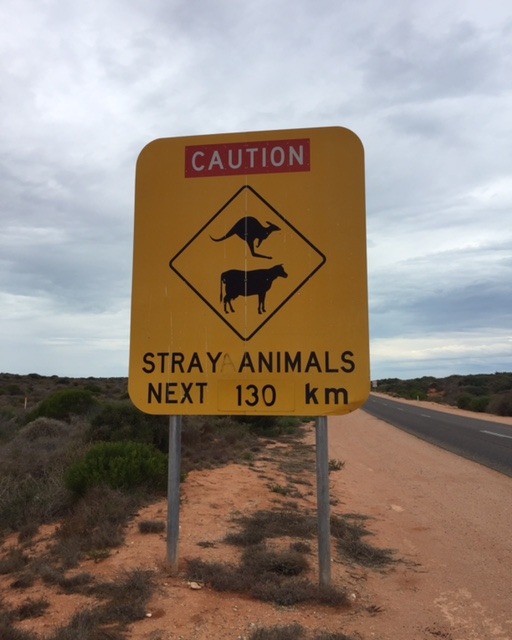
Signs announce the possibility of animal encounters. Most of the silhouettes were recognizable but we’d see an occasional warning for weird rat creatures with big ears or vague furry things. Crashing into an animal is a very real possibility on the North West Coastal Highway, and the evidence was bloody and everywhere. The kids were tasked with being spotters, which meant a lot of “goats on right,” or “freaky thing on left” coming from the backseat. We saw kangaroos, wild horses, wallabies, wallaroos, and countless lackadaisical goats. So many oddities of every shape and size. Did you know that goats and sheep are now having sex with each other? In Australia, their offspring are referred to as “halfsies.” What’s next? Equal pay for women? Crikey!

There are few places to fill the tank and buy more Arnott’s biscuits, and every stop felt like the scary bit before the opening credits – creaky screen door, flickering light bulb, an unusually warm and welcoming employee (alien in human form).

We made it to the national park without killing a single goatsheep blend. Now, the sun is setting over the Ningaloo Reef and we’re sipping Shiraz from Margaret River. The man who looks like David Duchovny is telling me about his recent kayaking adventure. I’d like to see an X-Files episode filmed out here. What do I know, maybe it was all filmed here as a docuseries. The truth is out there.

Doctor Hoo-Ha

“Remove your clothes from the waist down and hop up on the table. Let me know when you’re ready, sound good?” She smiles reassuringly and pulls the modesty curtain between us.

This is a doctor I can get behind. Or sprawl in front of. I am at a local clinic in Perth for a routine physical which, because I have a vagina, includes a pap smear. Now, in socks and a tank top, paper napkin across my lap, I tentatively say, “Ready,” as one might announce to an opponent in a face-slapping contest.

My doctor is dressed for a cocktail party. Full make up, tight floral dress, gold necklace. Strappy black platforms reveal a glossy red pedicure. “Your shoes are amazing,” I couldn’t help but remark when I walked into her office. In classic Aussie style, she shrugged off the compliment and told me they’re just for work because the rest of the time she’s in trainers running after her kids.

I know this will be quick. Appointments at this clinic are 15 minutes long – five minutes to express concerns about your health, and nine minutes for the doctor to investigate, suggest, and prescribe. The remaining seconds are for getting dressed and discussing payment, which, in a universal health care system, means cheers see ya. There’s no whinging. Australian GPs are mechanics, not therapists.

The doctor joins me on my side of the curtain. She’s in the same outfit but with new accessories – white latex gloves. “Pop your knees up. Scoot closer. Here we go.” As she’s inserting the speculum, I say a little prayer of gratitude. Thank you for not having a creepy moustache.

Ten years ago, I spent four months living in France in the former art studio of Anna Klumpke, a portraitist in the 1800’s who was known primarily as the lover of Rosa Bonheur, an animal painter who received a special dispensation from Napoleon III to wear pants. But I digress.

During that time, I had to look up “le gynécologue” in the phone book. I made an appointment with a doctor in the next town over. My French is ok but I’m no Charlotte Rampling, so to reduce my odds of telling a doctor there’s a croissant in my pantry, I brought along my Canadian friend Natalie who could help translate.

The doctor’s office was on a residential street in Fontainebleau, in a simple house with a wooden sign out front. I rang the bell. “Une minute. J’arrive.” His voice was low and stern. When he opened the door, I discovered the world’s best-kept secret.

Salvador Dali is not dead. He is working as a gynecologist in a picturesque town south of Paris. The moustache, the slicked back hair, crazy eyes, the whole thing. Natalie and I had a conversation with our eyes: “You’re going to let Salvador Dali touch your lady parts?” “Yes in fact I am going to let the famous surrealist painter examine me. I’m tired and I hurt.”

There was no waiting room, no secretary. Just a wood-paneled windowless room with a table and leather straps on loan from Frankenstein. Natalie explained my problem to Salvador. He muttered something I didn’t understand. Natalie looked intently at me and said, “He wants you to take off all of your clothes and lie down on this table.”

“All my clothes?”

“Yes. Everything.”

“Why my shirt and bra? Where do I change? Is there a robe?”

Sensing an uncooperative patient, Salvador sighed and grumbled at Natalie. All I could make out was something about “all Americans.” She said, “He says American women are very prudish and this is an insult.”

We left immediately. Natalie held my hand on the train. “I’m Canadian and would not have taken off all of my clothes either.” She suggested I call a hospital and request a female doctor. I did just that and secured an appointment with a kind, female, English-speaking doctor. In her brightly lit office, I asked her if I needed to fully undress. “Why would you need to do that?” she said. “Just your pants. I’ll turn around. Let me know when you’re ready.”

Now, a decade later, I zip up my linen pants and step out of the Perth clinic into a warm afternoon breeze. The wind is famous here, blowing in from the nearby port city of Fremantle and providing relief on hot days. Locals refer to it as the Fremantle Doctor.